Should Humanity Fear a Cashless Society?
Weighing efficiency, transparency and tax revenue against exclusion, predatory lending and the crime that adapts
Abstract
Thirty major airports have now adopted checkout-free retail, and each one removes the cashier along with the cash. This paper asks whether that trajectory should worry us. It sets the gains from a cashless economy, faster transactions, a smaller informal sector, harder money laundering and recovered tax revenue, against the costs, the 2.6 billion people still without internet access, the rise of predatory instalment lending, and the criminals who simply move to cryptocurrency. It concludes that humanity should not fear a cashless society, because the benefits outweigh the harms and the harms are themselves tractable.
In 2022, LaGuardia airport, in New York, became the first airport to adopt Amazon's "just walk out" technology. The software radically changes the store experience by cutting the checkout process. Instead of having their haul cashiered, individuals tap their credit to enter, pick up their items and "just walk out." This system works by tracking individuals' movement inside the store and scanning the items you pick up; to do this, you tap your card on the way in, like you do in the subway. Simultaneously, cameras track a person's movement, detect what is left with, before charging the previously tapped credit card. Since LaGuardia's adaptation, 30 major airports have adopted "just walk out" with many more on the way. This marks a major transition from a major cash exchange place to a seemingly cashless interaction. Although this seems like a brilliant futuristic idea, it comes with its drawbacks. Most notably, the technology replaces the need for cashiers. While the innovation takes society closer to economic efficiency, it also highlights the growing debate over whether humanity should transition to a cashless society. This paper concludes that humanity should not fear a cashless society.[1] This essay comes to this conclusion by weighing the improvements to humanity against the harms done, and reasoning that the pros outweigh the cons.
Efficiency
Cashless society leads to economic efficiency. When cash is removed, the time-consuming process of cash handling is replaced with the tap of a card or the typing of a Venmo transaction. Economically backed research[2] suggests that digital payment systems refine exchanges, making financial transactions faster and more correct. Research[3] suggests that one individual saves six seconds on a cashless transaction rather than using cash. Not only do cashless transactions save time, but they also cut the need for many transactions. For example, online portals can enable autopay where rent, utilities, subscriptions, and many more are all paid online without worry. Ultimately, by streamlining everyday payments and reducing the friction of manual cash handling, a cashless society creates a more efficient economy that helps both individuals and businesses alike.
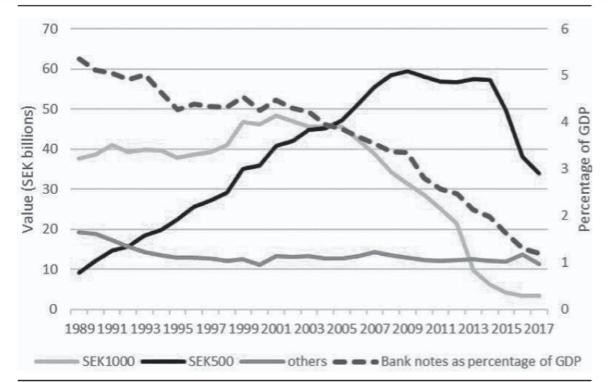
In addition to individuals saving time, financial institutions and producers also save valuable time through cashless interactions. Cashless societies represent a natural technological evolution that improves economic efficiency, transparency and innovation, as demonstrated by Sweden, where the adoption of digital payment services such as Swish has reduced cash usage to just 13% of all transactions compared to the EU average of 80% demonstrated in Graph 1. This cuts transaction processing times by up to 10 seconds per payment and streamlining corporate financial operations almost entirely. This is because small companies make thousands of payments each day, and cumulatively, time saved by a cashless society is great. Furthermore, large corporations benefit enormously, as automating thousands of daily transactions reduces overhead costs, minimizes human error, and frees up resources that can be reinvested into business development. Sweden proves how moving away from the reliance on cash can significantly improve the transaction speed and overall economic efficiency.[4]
The informal economy
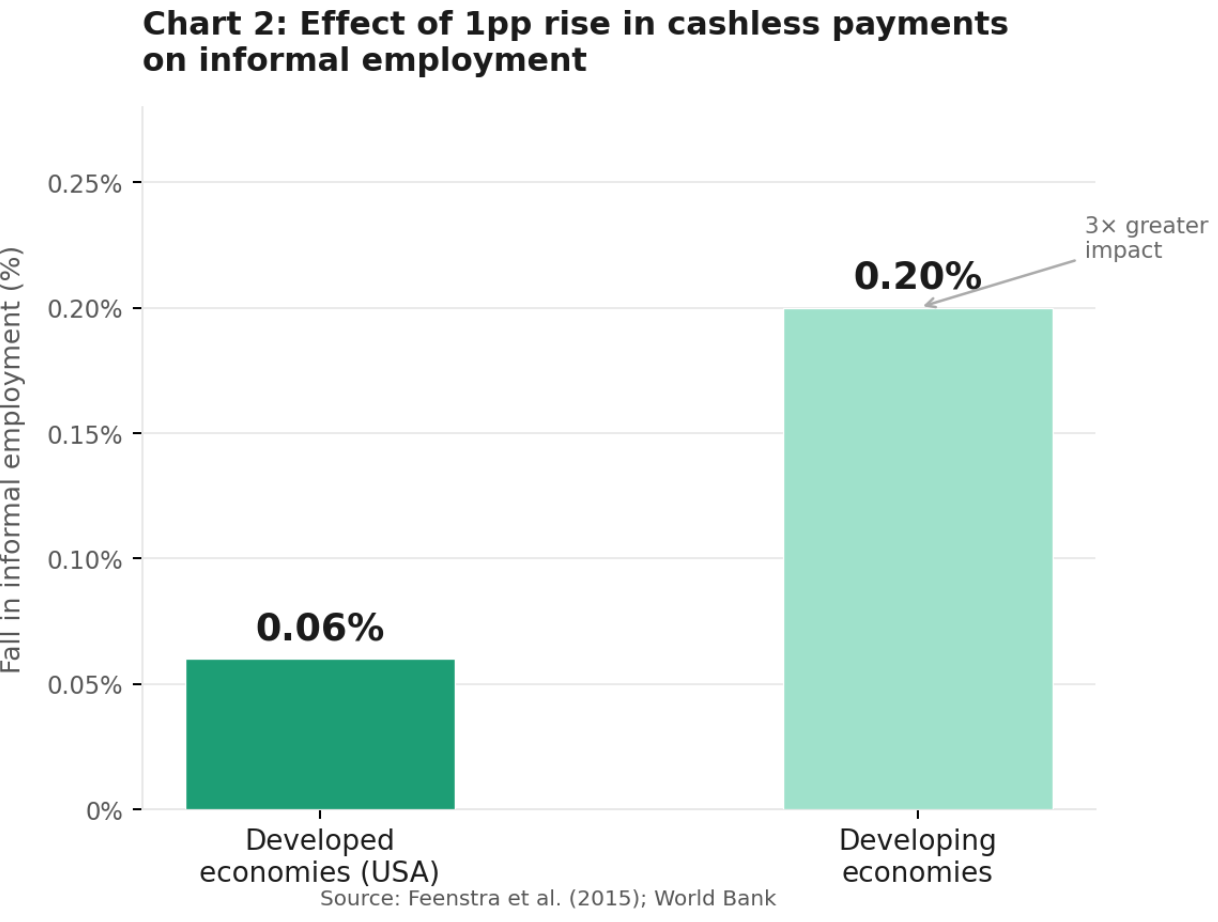
A cashless society reduces the informal economy and cash enabled money laundering by tracking transactions more efficiently. Digital payments make payments traceable, helping the government to formalize economic activity and improve tax compliance. If a person were to wake up and go to their neighbour, asking if they can mow the lawn for them and get paid in cash, they would not need to declare this and thus not pay any tax on it. Yet if we were in a cashless society, their neighbour would send them this through a digital payment, the transaction would be recorded and tax would be paid. Illicit transitions are also easier to find and track, due to digital payments. Research has found that by every one percentage point of cashless payment used in the USA, there is a decrease of 0.06% of informal employment. In developing countries, this percentage rises to 0.2% per 1%. Put together, Chart 2 proves that as cashless payments become more widespread, informal economic activity declines, bringing greater transparency to economies worldwide.
A cashless society limits the transaction anonymity that enables crime. All digital payments are traceable; thus, it is easier for the governments to trace illicit transactions, and tax avoidance. Because payments are done digitally in a cashless world, governments and organisations can now track payments in real life, allowing them to crash down on severe fraud. Consequently, large-scale financial investigations become far more effective. A cashless society also makes money laundering considerably more difficult. According to the United Nations Office on Drugs and Crime (UNODC), between $800 billion and $2 trillion, equivalent to 2 to 5% of global GDP, is laundered annually, a process that depends almost entirely on the untraceable nature of cash. In a fully cashless society, the anonymity that money laundering relies upon is taken away, standing for one of the strongest arguments for a cashless society.
Cybercrime
A cashless society reduces cybercrime. Every digital payment is recorded, timestamped, and traceable, stripping criminals of the anonymity they rely on. Cybercrime is being actively battled by governments as cybercrime is on the rise. Last year, the UK National Cyber Security Centre handled 204 major cyber-attacks, which is double of 2 years ago, which had just 89. This is because all digital payments and financial transactions are traceable, allowing for monitoring of all transactions in real time. For example, in 2022, the US Financial Crimes Enforcement Network found over $1.4 trillion in suspicious transactions through digital monitoring alone, something that would be impossible to achieve in a cash-based system. So, by monitoring illegal and unusual transactions, we can reduce cybercrime. Investigations are made easier via cashless societies, which reduces cybercrime.
Tax revenue and working conditions
The reduction of the informal economy coupled with robust transaction tracking has the added benefit of increasing the tax revenue. Currently in the UK, there is an estimated 46.8 billion pounds of tax evasion annually which stands for 5.3% of government revenue. In developing countries with higher percentages of informal employment, the unpaid tax amount is even higher. This is a significant loss of government revenue which otherwise could have funded public services, like the 780 million pounds deficit in the NHS or the small charities who had their funds slashed by the government. Digital payment trails give law enforcement real-time visibility over suspicious transactions, meaning that in a cashless society, the concealment of funds becomes far more difficult to achieve. Revenue is increased by 5-15% per hour in businesses and corporations[5], making cashless society a better and more practical possibility; supported by statistics from Sweetgreen. By reducing undeclared transactions and improving tax compliance, a cashless society can strengthen government revenue and public services.
The reduction in the informal economy leads to safer working conditions. According to the International Labour Organization, informal workers are significantly more exposed to poor working conditions due to the absence of formal oversight. The ILO states that by reducing cash-based, undeclared transactions, a cashless society encourages the transition of workers into the formal economy, where employment is safer, regulated, legally protected and with better wages. According to the International Labour Organization (ILO), 2 billion people over 60% of the world's employed population work informally, the majority lacking social protection, rights at work, and decent working conditions. Therefore, the global shift toward cashless transactions serves as a powerful mechanism for drawing workers out of precarious informal labour and into a regulated economy where their rights and safety are formally protected.
The case against
The rapid growth of the FinTech sector, while innovative, has introduced predatory financial products that exploit the frictionless nature of cashless spending. The growth of FinTech "Buy now, Pay Later" company (BNPL) companies, like Klarna, prove that a cashless society can enable new forms of predatory lending. Recently, BNPL companies have gained massive traction with companies like: Klarna, PayPal Pay and Affirm. These companies allow users to buy products and then split the bill into multiple instalments on everyday purchases such as a restaurant meal. This makes everyday purchases seem cheaper to the human eye; however, you are still paying the same price, with interest gaining if payments are missed. Research suggests that young users do not fully understand the long-term costs of BNPL. FCA suggests that 27% of UK adults use BNPL and with people having a 50% higher the chance of falling into debt. BNPL payments split bills into sections which seem manageable, however if the increased number of sections make it easier to miss a payment, making users incur high interest rates, and vulnerability of falling into debt. A further example is the growth of micro-investment and trading apps such as Robinhood, which similarly exploit the ease of digital access to encourage financially risky behaviour, particularly among younger users. Similar patterns of exploitation can be seen across a range of other digitally accessible behaviours like, crypto trading or sports betting. Consequently, while cashless systems offer convenience, they may also make financially irresponsible behaviour accessible at the fingertips.
With any modern technology, comes a lack of accessibility. In the UK, around 4.7 million people aged 65 and over lack the basic digital skills needed to use the internet successfully, and 2.3 million do not use the internet at all.[6] Furthermore, infrastructure in developing countries may not be equipped for a cashless society. According to the ITU, approximately 32% of the world's population, around 2.6 billion people, remain without internet access, meaning aspects of a cashless society would exclude a huge portion of the global population from basic economic participation, who are often the people and businesses least resourced to change.
In a cashless society, certain crimes, like drug dealing or cybercrime, are unlikely to be eliminated, as criminals are likely to adapt to changing circumstances.[7] Even with increased financial surveillance, criminals have already begun adapting by using cryptocurrency, which is significantly harder to trace than traditional digital payments.[8] According to Chainalysis, illicit cryptocurrency transactions reached $24.2 billion in 2023 alone. Furthermore, the Swedish and Norwegian governments have acknowledged that a fully cashless society does not guarantee security and are currently reconsidering their transitions due to concerns over state-backed threats, such as hackers from Russia. Therefore, while a cashless society reduces some forms of crime, it does not eradicate it, and criminals will continue to find ways to run outside the system.
Conclusion
A cashless society is the ultimate step in the finalisation of modern economics. Recent technological advancements made cashless society a practical alternative, allowing for greater economic efficiency. Humanity should look at the positive sides of a cashless society, which greatly shadow the negative aspects such as cybercrime which can be combated and reduced to marginal rates. A cashless society would boost already growing sectors and allow for economic stability. However, we should be aware of dangers such as online gambling, and unethical financial services. A cashless society should be recognized as a new challenge for humanity that should be overcome and implemented in the modern world.
References
References
-
Engert, W., Fung, B. S. C. and Hendry, S. (2018) Is a Cashless Society Problematic?, Staff Discussion Paper 2018-12, Bank of Canada. ↩
-
EY, Socioeconomic Impact of Electronic Payments (Germany). Available at ey.com. ↩
-
International Journal of Economics and Financial Issues. Available at econjournals.com. ↩
-
See Chart 2. ↩
-
Federal Reserve Financial Services, Cash Me If You Can: Impacts of Cashless Businesses on Retailers, Consumers and Cash Use. Available at frbservices.org. ↩
-
Older generations may not be as comfortable or used to modern technology, and the riddance of cash will present problems for them. ↩
-
Cybersecurity Ventures, Hackerpocalypse: A Cybercrime Revelation (2016). Available at cybersecurityventures.com. ↩
-
Traceable Payments and VAT Design: Effects on VAT Performance, CESifo Economic Studies, Oxford Academic. ↩